Monday, September 29, 2025

Packer, Merchant, Theater Enthusiast, and Boise Mayor James Pinney [otd 09/29]

James Pinney. H. T. French photo.
James A. Pinney – dubbed the “Father of Modern Boise” by historian Hiram T. French – was born September 29, 1835, near Columbus, Ohio. The family later moved to Iowa, and from there James traveled to California. He spent many years in California, returned to Iowa, then prospected around Pike’s Peak in Colorado and the Rogue River in Oregon. He saw some action in the Rogue River Indian War.

In 1862, he led pack trains from Oregon into the lower Salmon River gold fields. The following year, he moved to Idaho City and opened a general store. Pinney also built a theater there. Unfortunately, he had to rebuild his store after one of the fires that swept through the town [blog, May 17] burned him out. In 1872, Pinney moved to Boise City to operate a bookstore he had opened there three years earlier.

The Owyhee Avalanche in Silver City, Idaho told (August 26, 1876) its readers that James Pinney & Co. had forwarded the “latest numbers of Frank Leslie’s Illustrated and Harper’s Weekly. Messrs. P. & Co. are agents for these and many other publications and will fill all orders that may be forwarded [to] them for any of the same from any section of the Territory.”

In 1881, Boise City voters elected Pinney as their mayor and he set out to correct some deficiencies in the town’s infrastructure: The city purchased the main private bridge across the river and did away with its toll schedule. It also designated a new area for the cemetery, today’s Morris Hill Cemetery.

Leading by example, Pinney personally paid for a concrete sidewalk on the block in front of his own home. Others soon followed his lead. During a second term, the mayor directed the construction of Boise’s first sewer system, and grew the town by annexing a half-mile wide area extending to the river itself.

Boise City had made do with various small schools – some subscription, some free. In 1881, the Territorial Legislature created the Boise Independent School District. Under Pinney, the city opened the all-grades “Central School” near downtown. Critics complained that the facility was too large … a waste of tax dollars. A rapidly growing student population soon proved the administration’s far-sighted wisdom.

Pinney declined to run for the next two mayoral terms, but served two more starting in 1889. The mayor again encouraged progressive developments around the city. That included several private facilities – an electric trolley, a Natatorium that used natural geothermal waters, and a fine new bank. Pinney also spearheaded construction of a new City Hall, opened for use in May 1893.
Downtown Boise, ca 1898. [Illust-State]
Pinney did not run again for mayor until 1903, when he lost. He won two years later. During this, his final term, Pinney focused on expanding and upgrading the sewer system, and improving Boise’s streets. Traffic jams due to increased automobile use had already been reported in several cities. The mayor saw that thoroughfares of graded dirt and gravel would soon be unacceptable.

A committed theater fan, Pinney gave Boise City the Columbia (a state-of-the-art, for 1892, opera house) and then the Pinney Theater in 1908. French’s History asserted that The Pinney “would do credit to a city of several times Boise’s population.”

Although James seemed in good health for a man of 78, he took ill and died suddenly in February 1914.
                                                                                                                                     
References: [French], [Illust-State]
Sue Paseman, Ann Felton, “Father of Modern Boise: James Alonzo Pinney,” Mayoral Albums – Portraits of Boise Mayors, Boise State University (2004-2009).

Sunday, September 28, 2025

Army Pathfinder John C. Fremont at The Cedars on the Snake River [otd 09/28]

John C. Fremont, ca 1861-1865.
Matthew Brady photo, Library of Congress.
On September 28, 1843, an expedition led by Second Lieutenant John C. Frémont reached a point along the Snake River that would later be called “The Cedars.”

In August, Frémont’s command had explored the area around the Great Salt Lake, and then turned north into Idaho. At various times he sent men, including famous guide Kit Carson, to Fort Hall for provisions. In the 1830s, Carson had trapped much of northern Utah and southern Idaho. He learned more about trails further west from trappers and traders who had been to the coast and back.

Frémont first gained a name for himself on successful surveying expeditions between the Mississippi River and the Rocky Mountains. That notoriety and his personal charisma allowed him to woo and wed Jessie Benton, daughter of Missouri Senator Thomas Hart Benton. (This despite the stigma of Frémont’s illegitimate birth.)

With Senator Benton’s backing, Frémont led successive survey parties west, including one that reached Wyoming’s South Pass, and then this 1843 trek. In mid-September, they left the Bear River watershed and marched toward the Snake River, camping near American Falls. Then, for September 28th, Frémont wrote, “at evening we found a sheltered camp, where there was an abundance of wood, at some elevated rocky islands covered with cedar, near the commencement of another long cañon of the river.” [My emphasis.]

Sixty years later, Milner Dam [blog, May 7] would be built near Frémont’s campsite at The Cedars. However, the presence of the Snake River canyon was of more immediate concern, because downstream from their camp it was almost impossible to descend to obtain water. Instead, they had to cut across a largely arid, sometimes rocky plain. Frémont wrote, “We encamped about 5 o’clock on Rock Creek – a stream having considerable water, a swift current, and wooded with willow.”

The next day brought another distinctive landmark. Frémont wrote, “Immediately opposite us, a subterranean river bursts out directly from the face of the escarpment.” Crystal Spring is a feature of today’s Thousand Springs State Park.

Three days later, they encountered the difficult Snake River ford that later travelers called the “Three Island Crossing,” near today's Glenns Ferry. Early fall rains had caused the river to rise, and the surveyors had to resort to their inflatable boat to cross.

Four days after that, Frémont wrote, “We came suddenly in sight of the broad green line of the valley of the Rivière Boisée (wooded river).”

After noting that the upstream course turned sharply into “lofty mountains,” the party descended to “the bottoms of the river, which is a beautiful rapid stream, with clear mountain water, and, as the name indicates, well wooded with some varieties of timber – among which are handsome cottonwoods.”

Old Fort Boise, E. Weber & Co. Lithograph.
National Archives.
They followed along the river to (old) Fort Boise, where, Frémont said, “We were received with an agreeable hospitality by Mr. Payette, an officer of the Hudson’s Bay Company.”

They again used their boat, and two borrowed canoes, to cross the Snake River, which they found “broad and deep.” The following day they crossed the future Idaho-Oregon border into “very mountainous country.” The party arrived at the first white settlements in late October. Frémont and a few men went on to Fort Vancouver.

To that point, just over a thousand emigrants had crossed Idaho into Oregon, relying on advice from trappers and sketchy missionary reports. Frémont’s published report, with maps, became a vital guide for Oregon Trail pioneers who followed much the same route across Idaho.
                                                                                                                                     
References: [Brit]
Brevet Captain J. C. Fremont, Report of the Exploring Expedition to The Rocky Mountains … [1842-1843], Printed by order of the Senate of the United States, Washington D.C. (1845).
Jim Gentry, In the Middle and On the Edge, College of Southern Idaho (2003).
John D. Unruh, Jr, The Plains Across, University of Illinois Press, Urbana (1979).

Saturday, September 27, 2025

Physician, Businessman, and Civic-Improvement Leader Robert Lee Nourse [otd 09/27]

Dr. Nourse. Illustrated History photo.
On September 27, 1864, Boise physician Dr. Robert Lee Nourse was born about 45 miles southwest of Louisville, Kentucky. He came from a distinguished lineage, with ancestors who fought in the American Revolution. Moreover, one of those hung during the hysteria of the Salem witch trials was his many-times-removed grandmother, Rebecca (Towne) Nurse.

He attended a high school academy in his home state and then, at age seventeen, went to work in an Uncle’s hotel in Wisconsin. After several years there, he entered the Rush Medical College in Chicago. Robert completed his medical degree in 1889 and opened a practice at a lake port east of Duluth. He then worked with an eye, ear, nose and throat specialist in Chicago for two years before returning north.

In 1897, Dr. Nourse moved to Hailey, Idaho, where he developed a thriving general practice. Within a year or so, the governor appointed him to the Idaho Board of Medical Examiners, which he served as secretary and treasurer. A member of the State Medical Society, Nourse was the organization’s President in 1905 (Idaho Statesman, October 6, 1905).

During his address to the Society, Nourse roundly criticized a judge who had tried to overturn a Board decision denying a license to one applicant. (The judge had taken it upon himself to “materially raise” the applicants grades.) The judge responded by slapping Nourse with a contempt charge and a $300 fine. In the end,  physicians statewide chipped in to pay the entire amount.

Soon after that, the Idaho Supreme Court ruled (Idaho Statesman, January 21, 1906) that the Board had acted properly, within the powers granted to it by the legislature. (The Court did not address the matter of the contempt charge.)

By the time all this happened, Nourse had left Idaho for an extended course of specialist study, first in New York City and then in Europe.

Upon his returned, he opened a practice in Boise, specializing in eye, ear, nose and throat medicine. Certified by the American Board of Otolaryngology, Dr. Nourse was also a Fellow of the American College of Surgeons.

Along with his practice, Dr. Nourse invested in a wide variety of business enterprises. For example, he served as a Director and also acted as Secretary for the Empire Hardware Company. He was associated with the YMCA, YWCA, and the Presbyterian church.

His wife, Marie, became a leader in several civic improvement organizations, including a term as President of the Columbian Club. Some of their causes included improvements at the library, creation of parks, and a campaign against objectionable street signs. She appeared in the 1914-1915 issue of Who’s Who in America (The American Commonwealth Company, New York, 1914).
The source caption for the photograph says the American
driver of the ambulance was killed in November 1916.

The couple's two sons, Robert L., Jr. and Norman C., served with the American Field Service in France during World War I. The AFS provided volunteer ambulance drivers to recover wounded from the front lines – the first time motor vehicles had been used for that purpose. Robert Jr. was burned about the face and eyes by mustard gas and also received the Croix de Guerre.

In 1918, Dr. Nourse helped organize Idaho’s section of the nation-wide Volunteer Medical Service Corps (Idaho Statesman, August 30, 1918). For many years, Dr. Nourse served on the staffs of St. Luke's and St. Alphonsus hospitals in Boise. He passed away in June 1949.
                                                                                                                                     
References: [French], [Illustrated-State]
History of the American Field Service in France, Houghton Mifflin company, New York (1920).
"Cite American Officer: French Decorate Lieut. R.L. Nourse, Jr., for Bravery Under Fire," New York Times, (March 3, 1918).

Friday, September 26, 2025

Loyal P. Brown: North Idaho Merchant, Rancher, Developer, and Legislator [otd 09/26]

Loyal P. Brown.
Historical Museum at St. Gertrude,
Cottonwood, Idaho.
North Camas Prairie businessman, rancher, investor, and public servant Loyal P. Brown was born September 26, 1829 in Stratford, New Hampshire, in the northeast corner of the state.

His mercantile experience began when he was 16 years old. After a few years of that, he became a Forty-Niner, traveling the isthmus route to California. He did well in the gold fields, and then with stores he opened in northern California and in Oregon. After a year back East, he returned to Oregon and settled in the Umpqua Valley.

When gold was discovered near Florence, he brought his family to Idaho. In July 1862, they reached the waystation of Mose Milner, near the southeast edge of the Camas Prairie. Sensing opportunity, Brown and a partner purchased what would become Mount Idaho.

Brown, a life-long temperance advocate, disagreed with his partner about building a saloon onto the hotel, so Brown bought him out three years later. The structure then housed a post office, with Brown as postmaster, and a modest store. L. P. also opened a small blacksmith shop. Brown’s holdings grew extensively: many leased lots in Mount Idaho, a grist mill, another store in Elk City, and a substantial ranch. The ranch held “quite a band of cattle” and exported horses into Montana.
Mount Idaho Courthouse, built in the early 1870s. [Hawley]

Brown represented Nez Perce County on the 1874-75 Territorial Council. (He had also held that office in 1866-67.) During that session, he worked a bill through the legislature that redrew county boundaries, resulting in the selection of Mount Idaho as the county seat of Idaho County. That fueled even further growth before the Nez Perce War broke out.

L.P. played a major leadership role in the 1877 War: His dispatches provided the first warning of the outbreak to the Army units at Fort Lapwai. He also supplied materials and supervised construction of a hastily-built stockade on a hill just north of Mount Idaho. Rifles could still cover the town from the high ground, while the fort provided shelter for all who had to flee their homesteads.

Brown expanded further after the war. Merchants added new structures on a hill just north of Mount Idaho. and he built a steam sawmill northeast of town. Elsewhere, he bought up much of the town of Cottonwood and encouraged its growth: a post office in 1879, a blacksmith shop, and, in 1880, a store and Brown’s own hotel. For four to five years during the mid-Eighties, the town also served as a gathering center for cattle and horses. Cottonwood became quite a lively place during the main roundups, and locals recalled informal rodeos with bronco and bull riding.

During the early 1880s, Brown broadened his holdings even more to include six or seven thousand head of sheep along with his cattle and horses. Of course, he wasn’t the only stockman. On July 20, 1885, ranchers in Idaho County created the Idaho County Stock Growers' Association. (As elsewhere in the state, one of their main concerns was rustling). The Association elected Brown as its first president.

Settlers continued to arrive in the area and, in July and August of 1887, leaders organized the Idaho County Pioneer Association [blog, July 16]. Again, L. P. Brown was its first president.

Brown even found time to invest in Clearwater mining ventures. However, he sold perhaps his most promising lode mine property to a California firm in early 1894. He passed away in April 1896.
                                                                                                                                     
References: [Illust-North]
M. Alfreda Elsensohn, Eugene F. Hoy (ed.), Pioneer Days in Idaho County, Caxton Printers, Caldwell, Idaho (1951).

Thursday, September 25, 2025

Idaho Attorney General Roy Black, "Lady Bluebeard" Prosecutor [otd 09/25]

Attorney Roy Black.
J. H. Hawley photo
Idaho Attorney General Roy L. Black was born September 25, 1878 in Lagrange County, Indiana, about forty miles east of South Bend. He became a teacher at an early age and continued for a number of years in the county schools near his parent’s home. After some advanced study at Valparaiso University and an institute in Michigan, he entered the University of Michigan Law School.

Roy drove a stagecoach in Yellowstone National Park during one summer while he was at the University. He graduated with an LL.B. in 1907, having served as Associate Editor of the Michigan Law Review during his junior year. Soon after graduation, Black formed a partnership with Nicodemus D. Wernette, a Law School classmate, and they moved to Coeur d'Alene.

Earlier that year, Kootenai County had been drastically reduced in size by the creation of Bonner County. Coeur d'Alene became the county seat of this smaller Kootenai County in 1908.

The firm of Black & Wernette operated successfully for over a decade, even as the partners also found positions in public service. In 1909, Black was elected to a two-year term as City Attorney for Coeur d'Alene. The following year, Wernette was elected Prosecuting Attorney for Kootenai County, and Black was elected to a term in the Idaho House of Representatives. There, leaders made him chairman of the Judiciary Committee.

During his term, Roy sponsored an act known as the “Black Law,” which allowed cities of over 2,500 population to adopt a commission form of government. The Black Law generated a great deal of controversy, especially when advocates applied it to Boise, which operated under a special Charter. Still, in a close election (52-48%), voters did overturn the Charter.

In 1918, the Republican Party nominated Black as their candidate for Attorney General and he won easily. He was also elected for a second term.

The most famous case of Black's period as Attorney General involved the trial of serial killer Lyda Southard, variously known as “Idaho’s Lady Bluebeard,” “Flypaper Lyda,” Lyda Trueblood (her birth name), or any of her numerous married names.
Lyda [Southard etc]. Associated Press.


Lyda’s family had moved to Twin Falls in 1906. There, in 1912, she married Robert Dooley, who died three years later. Forensic evidence eventually showed, with varying degrees of certainty, that he, his brother, a daughter, and three husbands that followed, all died from arsenic poisoning – apparently extracted from many, many sheets of flypaper.

Paul Southard, her husband at the time of the trial, escaped that fate, as did two later spouses. Showing arsenic as the means, life insurance payoffs as the motive, and (sometimes) apple pie as the opportunity, Roy and the team of prosecutors convicted Lyda for the murder of her fourth husband.

In 1923, after his final term as Attorney General, Black moved to Pocatello. There, he became heavily involved in legal issues associated with reclamation and irrigation enterprises. He played a role in the American Falls Dam Project. Besides his thriving law practice, he also served as Chairman of the Pocatello school board in 1929, and was an active member of the Chamber of Commerce. 

In 1937, Roy’s son John, who had attained a law degree three years earlier, joined him in his practice. In 1950-51, the two were involved in a very interesting dispute in Chubbuck (just north of Pocatello). One faction wanted to incorporate 15 acres containing just the business district, rather than the 345 acres approved earlier by the county commissioners. The advocates for the larger size won

Roy retired in 1965, when his wife of over fifty years died. He passed away in August 1970. In honor of his long association with the Pocatello Elks Lodge, the Exalted Ruler conducted his funeral.
                                                                                                                                     

References: [Blue], [French], [Hawley]
William C. Anderson, Lady Bluebeard: The True Story of Love and Marriage, Death and Flypaper, Fred Pruett Books (1994).
“Roy L. Black – Longtime Pocatello Attorney Dies,” Idaho State Journal, Pocatello, Idaho (August 16, 1970).
“[Chubbuck Size Dispute],” Idaho State Journal, Pocatello, Idaho (December 1950 – February 1951).
“‘Flypaper Lyda’ and Her Special Apple Pie,” Newsletter, Idaho Legal Historical Society, Boise Idaho (January 2010).

Wednesday, September 24, 2025

Cattleman Con Shea Drives Texas Longhorns to Owyhee Ranches [otd 09/24]

On September 24, 1870, the Owyhee Avalanche (Silver City, Idaho) published the following item: “From Texas – Con Shea, one of Owyhee's most adventurous and enterprising citizens, just got back from Texas. He and Tom Bugbee left here in March last, since that time they have purchased in Texas, and driven to within one hundred miles of Denver City, some 1300 head of cattle. Bugbee remains with the stock, which will winter on the waters of the Arkansas river. Grass is very short along the route, which accounts for their not coming on this season.”
Longhorns on the move.
International Texas Longhorn Association.

Originally from Canada, Cornelius “Con” Shea arrived in Idaho in the spring of 1864. He worked as a miner and then teamster for awhile, but by 1867 had established himself as a cattleman. The following year, a well-off rancher bankrolled him to go to Texas and bring back a herd of longhorns. (Texas had a “glut” of cattle, and prices were low.)

Con started east, but at Raft River ran into a drive already on its way from Texas. The owners agreed to sell him the herd. Con drove the cattle to range along Sinker and Catherine creeks (southeast of today’s Murphy). These are believed to be the first Texas cattle brought into the “Owyhee Country” of southwest Idaho and southeast Oregon.

The following year, Con and some other cattlemen bought longhorns along the Brazos River in Texas and drove them to Idaho. As noted by the lead newspaper item above, Con repeated the process in 1870. Many of these cattle went, as needed, from the range to meat markets in the Owyhee mining camps. But ranchers like Shea also began to build up their breeding stock.

In 1874, Con moved his herds to grazing land that straddled the Oregon border, about 15 miles northwest of Silver City. He and a brother also ran a meat market in a mining camp that flourished near Silver City from 1871 to about 1876. Con and two of his brothers took part in the Battle of South Mountain during the Bannock War of 1878 [blog, June 8]. For the next twenty years, Shea played a major role in the Owyhee Country cattle business. He left his name on Idaho’s Con Shea Basin and on Sheaville, Oregon.
Con Shea, ca 1898.
Savings Bank of Santa Rosa.

Around 1883, Shea purchased a winter home in Santa Rosa, California. After that, he “commuted” to Idaho and Oregon to oversee his ranch and business properties. Local newspapers usually referred to his town visits with the lead: “Con Shea of Cow Creek ...” (Cow Creek rises about ten miles northwest of Silver City.)

After the Oregon Short Line laid tracks across Idaho, Shea began selling cattle to the Eastern markets. Thus, the Owyhee Avalanche in Silver City, Idaho, reported (July 4, 1885) that Shea had sold a consignment to a company in Chicago. The item said he was about to “turn over 1500 or 2000 head to the agent of the firm at Caldwell.”

Around 1897, Shea disposed of his Idaho and Oregon ranch holdings and moved permanently to Santa Rosa. There, he had invested in land and other real estate, and served as Director of the Savings Bank of Santa Rosa. After the 1906 Bay Area earthquake, a Santa Rosa newspaper lauded the fact that Shea intended to rebuild his commercial properties using reinforced concrete.

Con passed away in May 1926.
                                                                                                                                     
References: [Illust-State]
Mildretta Adams, Owyhee Cattlemen, 1878 – 1978, Owyhee Publishing Co., Homedale, Idaho (1979).
Adelaide Hawes, Valley of Tall Grass, Caxton Printers, Caldwell, Idaho (1950).
A Historical, Descriptive and Commercial Directory of Owyhee County, Idaho, Owyhee Avalanche Press (January 1898).
“Savings Bank of Santa Rosa,” Sonoma County Homes and Industries, Reynolds & Proctor Publishing, Santa Rosa, California (1898).
“Solid Block of Concrete: Santa Rosa Will Have Substantial Structure,” Santa Rosa Republican (July 16, 1906).  

Tuesday, September 23, 2025

Lewis & Clark Return to St. Louis, First Train Arrives in Moscow [otd 09/23]

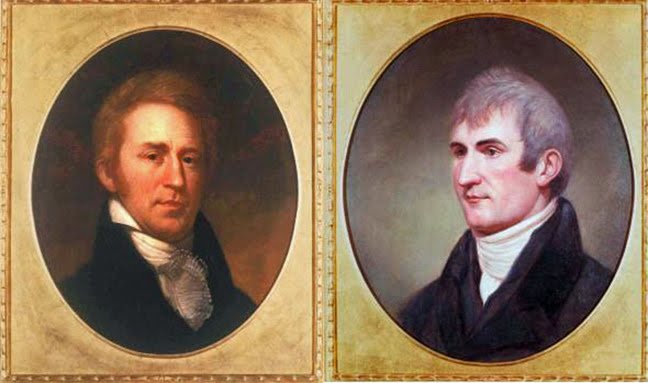
On September 23, 1806, Sergeant John Ordway wrote in his journal, “About 12 oClock we arived in site of St. Louis. Fired three rounds as we approached the Town and landed oppocit the center of the Town, the people gathred on the shore and Huzzared three cheers.”

Portraits of William Clark and Meriwether Lewis.
Independence National Historical Park, National Park Service.
The Lewis and Clark Expedition had been gone from St. Louis just about 28 months. Their exploration of the Louisiana Purchase territory, and beyond, was a monumental achievement, which needs no further elaboration here. Still, there are two points worth mentioning, one striking an ironic note.

Just over a month earlier, the captains granted Private John Colter an early discharge from the Army so he could accompany two American hunters who were heading into the Rockies. Before he left the mountains for good in 1810, Colter trapped and explored southern Montana, northern Wyoming, and eastern Idaho. He was the first white man to traverse what later became known first as Pierre’s Hole, and is today the Teton Valley of Idaho [blog, Aug 17].

The irony lay in the presence of the two hunters, Joseph Dickson and Forest Hancock from Illinois: The government venture wouldn’t report officially for another six weeks or so, yet already daring and ambitious Americans were moving to explore the wild new territory. My favorite account of the Expedition is Stephen Ambrose’s Undaunted Courage: Meriwether Lewis, Thomas Jefferson, and the Opening of the American West (Simon & Shuster, New York, 1996).

Another OTD item appears in Hawley’s History: “In 1883 right of way was obtained for a branch between Moscow, Idaho, and Winona, Washington. Wednesday, September 23, 1885, was a red-letter day in Moscow's calendar, as on that day the first train arrived in that city. Salutes were fired, speeches made, and the celebration closed with a grand ball in the evening, at which several of the officials of the Oregon Railway & Navigation Company were present.”

Scattered settlers entered Paradise Valley around 1871. The area grew very slowly at first, but by a concerted effort, locals obtained a post office in 1872. By 1877, the post office had a new name -- Moscow -- and a new location a mile or so away. However, the town was just another small, isolated farm and ranch town until the railroad arrived.

Anticipating the arrival, the Portland Oregonian said (September 23, 1885), “Before dark tonight the track of the Oregon Railway & Navigation extension will have reached Moscow, Idaho.” The item noted that workers had completed the construction a week sooner then expected. It went on, “To-morrow the company will begin bringing wheat out of Moscow, and freight destined for that point will be received as soon as facilities can be provided for handling it, which will be about the last of this week.”

President Gault.
UI Archives.
As expected, the local economy surged. In describing the period before the national “Panic of '93,” the Illustrated History declared, “Moscow reached the high water mark of prosperity. Everybody made money and everyone had money, and the volume of business transacted here was enormous.”

In 1889, the legislature selected Moscow as the site for the land-grant University of Idaho, and facility construction began in 1891 [blog, Oct 3]. The school soon hired President Franklin B. Gault to replace an unpaid head.
                                                                                                                                     
References: [Hawley], [Illust-North]
Rafe Gibbs, Beacon for Mountain and Plain: Story of the University of Idaho, The Caxton Printers (© The Regents of the University of Idaho, 1962).
Burton Harris, John Colter: His Years in the Rockies, University of Nebraska Press, Lincoln (1993).
Meriwether Lewis and William Clark, Gary E. Moulton (Ed.), The Definitive Journals of the Lewis and Clark Expedition, University of Nebraska Press, Lincoln (2002).